
Finance: overview
What Finance is for
Every other section of enSights deals in energy. Finance is where that energy becomes money. It holds the commercial agreements behind each site, turns metered production into invoices, tracks whether a project is actually making the return it promised, and — for new storage projects — estimates the return before you build.
The people who live in this section are usually not the same people who live in Monitoring & Control. Asset managers, controllers and commercial teams work here; the link between the two worlds is the meter reading, which flows from the monitoring side into the contract calculations without anyone re-typing it.
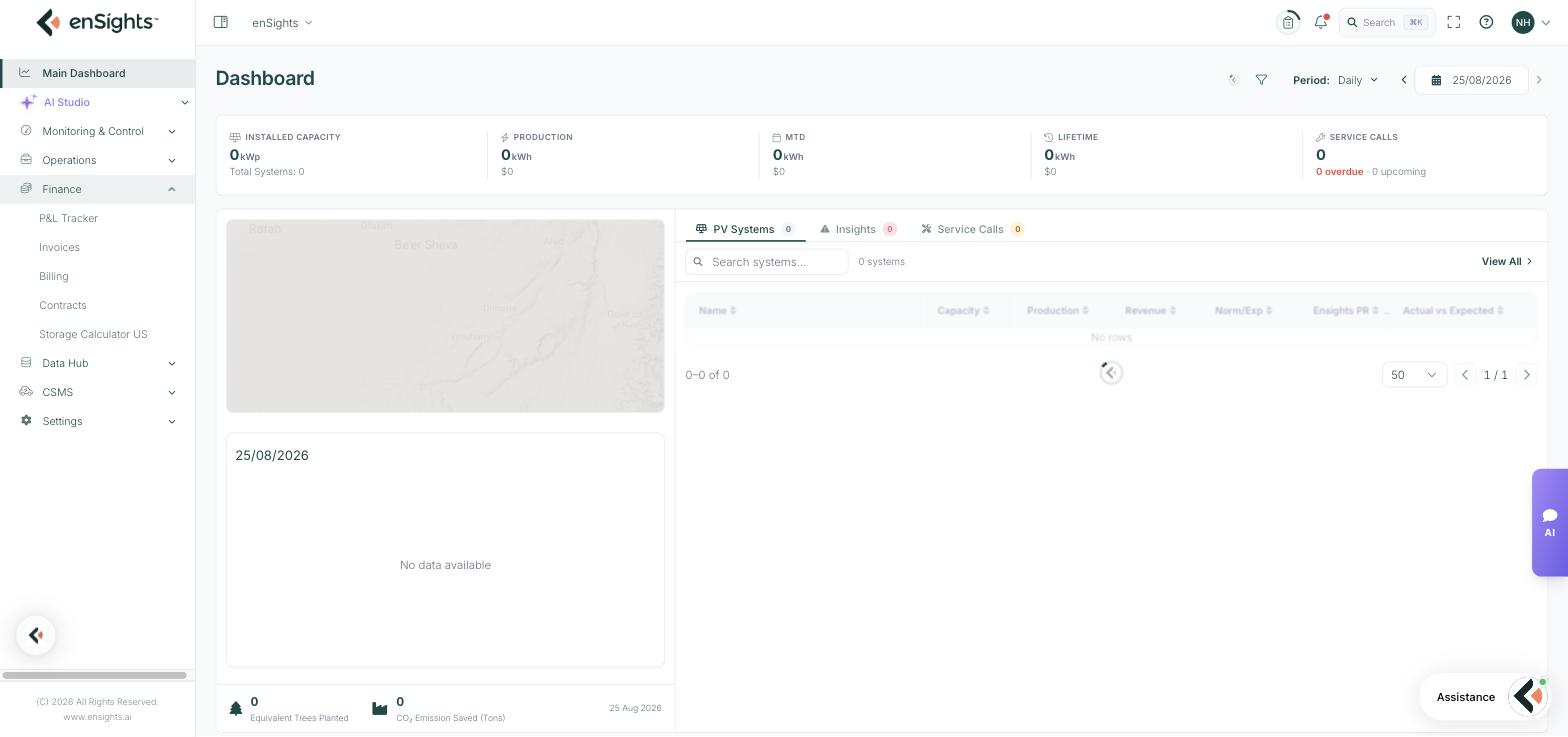
The five pages
Page | What it does |
|---|---|
P&L Tracker | Actual versus expected financial performance per project, month by month, from revenue down to cash flow. |
Invoices | The invoices enSights generates from contracts and meter data, with their delivery and payment status. |
Billing | The customer-facing invoice ledger for your own account. |
Contracts | The agreements themselves — PPAs and subscriptions, their rates, escalation, tax and payment terms. |
Storage Calculator US | A feasibility model for new battery projects in US markets: savings, payback, IRR and NPV. |
How the pages fit together
Four of the five form a chain, and it is worth reading it in order because each page consumes what the one before it produced:
- Contracts is the source of truth. A contract says who is buying, at what rate, with what annual escalation, what tax treatment, and on what payment terms.
- Meter data from the monitoring side supplies the volumes — the kWh actually delivered in the billing period.
- Invoices is contract times volume. The rate structure and the metered energy produce a document you can send, and the page then tracks whether it was sent, viewed and paid.
- P&L Tracker aggregates that revenue, subtracts operating costs, capex and debt service, and shows the resulting cash flow against what the model expected.
Storage Calculator US sits outside that chain. It is a pre-investment tool: it models a project that does not exist yet, so nothing in it comes from or feeds back into your live contracts.
Two pages still on the previous interface
P&L Tracker, Invoices and Storage Calculator US use the current enSights interface. Billing and Contracts still open in the previous one — a different header, a different table style, and a full page load rather than an in-place transition. The data is the same and the pages are fully supported; only the styling differs. Reach them from the left navigation rather than by typing a URL, because their addresses do not follow the same pattern as the newer pages.
Where the numbers come from
- Revenue is calculated, not entered. It is the contract's rate structure applied to metered energy for the period, which is why a wrong rate or a missing meter shows up as a wrong invoice rather than an error message.
- Expected figures in the P&L come from the project model set up when the asset was onboarded. When actual and expected diverge, one of them is wrong — and it is worth deciding which before acting on the gap.
- Escalation is applied per contract year, not per calendar year, so a mid-year contract start means the rate step happens mid-year too.
- Tax is a contract-level setting. Changing it changes future invoices, not ones already issued.
Who can get here
Finance is permission-gated in Settings → Roles & Permissions, and the pages are gated separately: a role can hold invoicing rights without contract-editing rights, or read-only access to the P&L without either. If you can see the Finance section but a page is missing from it, your role doesn't carry that page's permission — Team Management and Roles & Permissions in Settings is where that is changed.
Things worth knowing before you start
- An invoice is a document, not a draft view. Once generated it reflects the contract as it stood at generation time. Fixing a rate afterwards does not retroactively fix an issued invoice.
- Contract changes are wide. Payment terms, escalation and tax apply to every future invoice under that contract, across every site attached to it.
- Comments in the P&L are the audit trail. A variance nobody explained looks identical to a variance nobody noticed. The per-cell comment is how the explanation stays attached to the number.
- The Storage Calculator is an estimate. It uses published tariff and incentive data per state, refreshed periodically. Treat its output as a screening result, not a bankable model.
Where to go next
- Setting up a new site's commercials? Contracts first — nothing downstream works without it.
- Chasing money? Invoices, filtered by status.
- Explaining a project's performance to an owner? P&L Tracker, with Show Expected turned on.
- Sizing a new battery project? Storage Calculator US.