
Finance: Revenue Assurance — Aggregators & Utilities
What this page is for
Aggregators & Utilities shows one card per counterparty. Aggregators are scored on how well their reporting matches the utility's data; the utility is the reference they are checked against and is never scored. Open it to see which aggregator to talk to, and to keep each counterparty's profile (reporting SLA, contact, file format) up to date.
Find it under Finance → Revenue Assurance → Aggregators & Utilities.
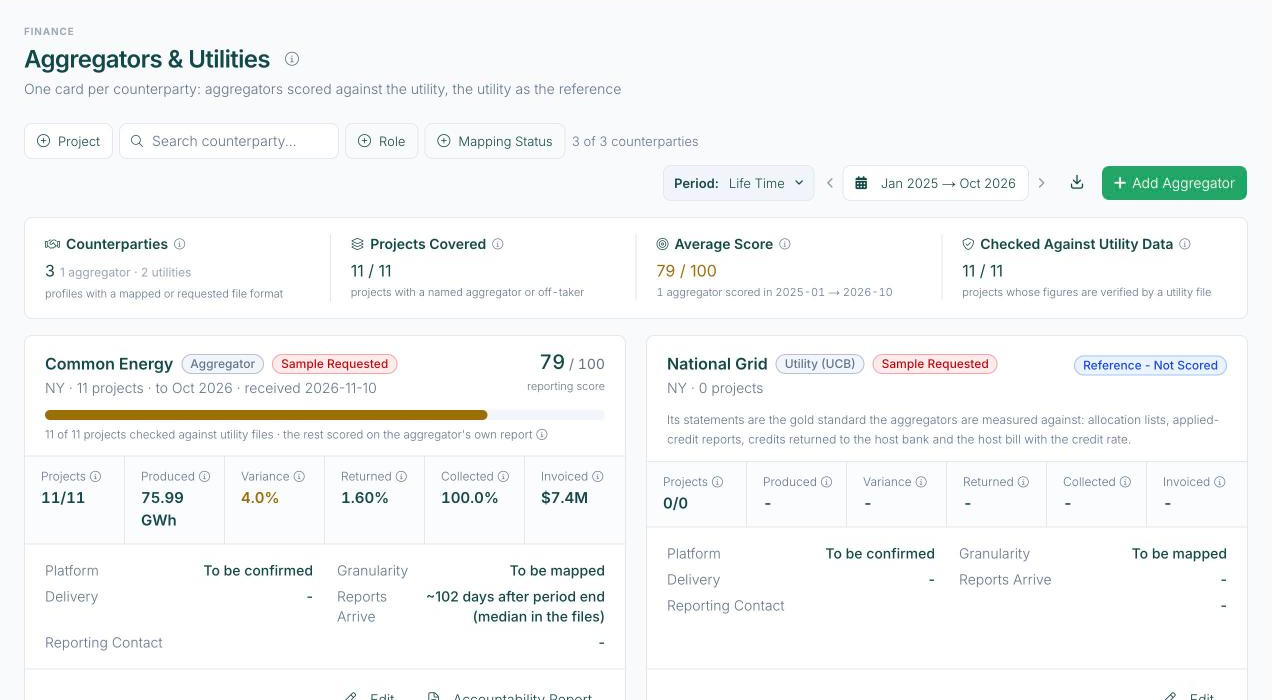
The toolbar
Control | What it does |
|---|---|
⊕ Project | Limits the page to the counterparties of the projects you pick. |
Search counterparty... | Finds a counterparty by name. |
Role and Mapping Status | Filter chips, each with a count per value. |
Period | Monthly, Quarterly, Annually or Life Time. Scores and figures follow it. |
Export CSV (download icon) | Downloads the counterparties and their figures. |
+ Add Aggregator | Creates a new aggregator, utility or off-taker profile. |
The KPI strip
Figure | What it shows |
|---|---|
Counterparties | Every aggregator, off-taker or utility with a profile. |
Projects Covered | Projects that name a counterparty. |
Average Score | The mean reporting score of the aggregators whose files reconcile in the period. |
Checked Against Utility Data | Projects that carry the utility's own allocation, applied-credit and host-bank reports. Only for these is the aggregator checked against an independent source. |
The counterparty card
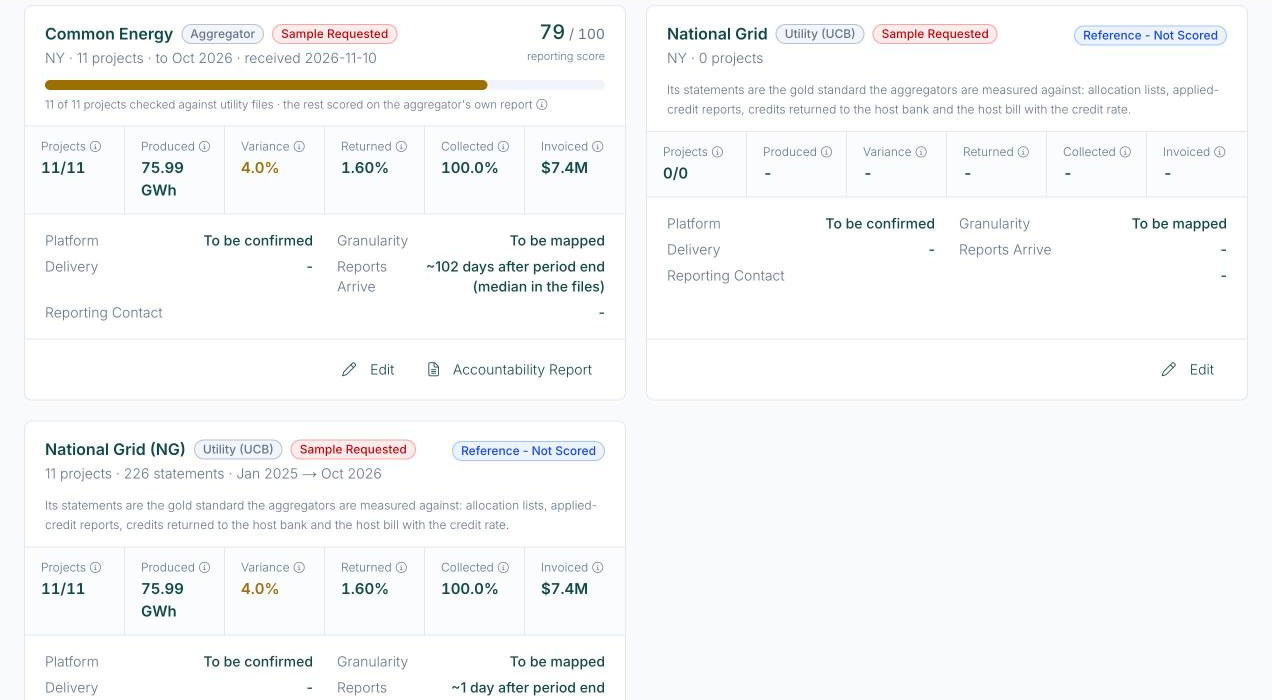
- The header shows the name, the role (Aggregator, Utility (UCB) or Off-taker), the mapping status of its file format, the states and projects it covers, and when its newest file arrived.
- An aggregator shows its reporting score out of 100 with a bar: green from 85, amber from 70, red below. A utility card reads Reference - Not Scored.
- Figures: Projects (with data / assigned), Produced, Variance, Returned, Collected and Invoiced. Hover the ⓘ for each definition.
- Profile: Platform, Granularity, Delivery, Reports Arrive (the median delay after period end, measured from the files) and Reporting Contact.
- Edit opens the profile. Aggregator cards also have Accountability Report.
The reporting score is 100 − rejection rate % × 8 − allocation gap % × 2 − past-due % × 1.5, floored at 0. Each term only counts when the file carrying it is loaded.
Editing a profile
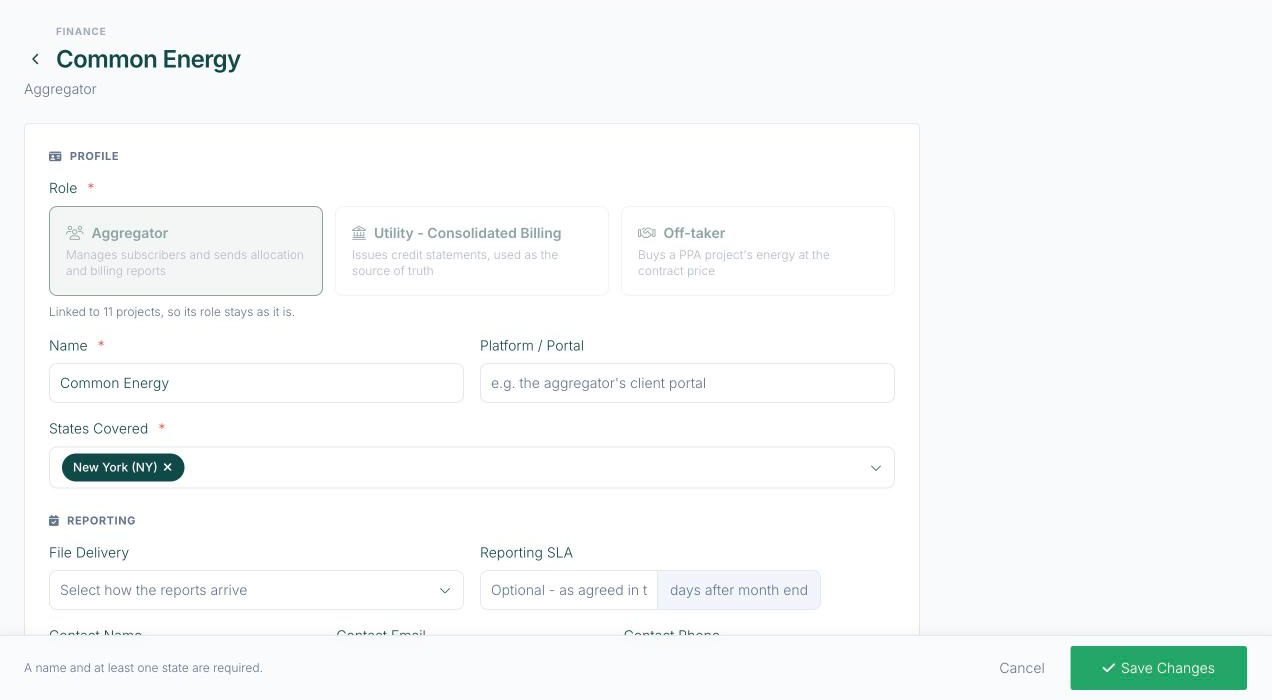
Edit opens the profile as a page:
- Profile: role, name, platform or portal, and states covered. The role is locked once the counterparty is linked to projects.
- Reporting: file delivery, reporting SLA (days after month end, as agreed in the contract), and the contact's name, email and phone.
A name and at least one state are required. Save Changes stores the profile; Cancel leaves without saving.
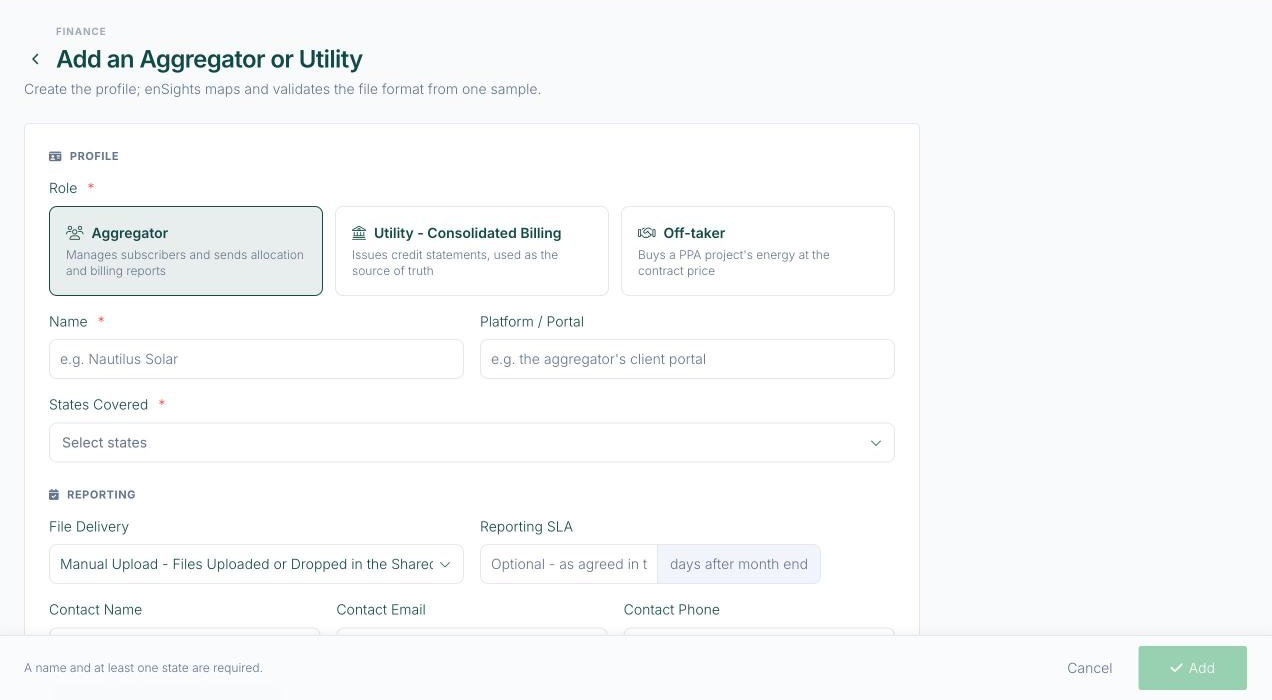
Adding a counterparty
+ Add Aggregator opens Add an Aggregator or Utility: pick the role (Aggregator, Utility - Consolidated Billing, or Off-taker), then fill in the profile and reporting fields as above. Under File Format, add a sample report (CSV, XLSX or PDF) to start the format mapping straight away. Click Add to create it.
How to
Decide which aggregator to call this month
- Sort your attention by the reporting score: red and amber first.
- On that card, read Returned and Collected to see whether the issue is allocation or cash.
- Open Loss & Root Cause for the account list to send.
Set up an aggregator before its first report
- Click + Add Aggregator and choose Aggregator.
- Enter the name, states, delivery and reporting SLA, and the contact.
- Attach a sample report so enSights can map the format, then click Add.
Hold an aggregator to its reporting SLA
- Click Edit and enter the reporting SLA from the contract.
- Compare it with Reports Arrive on the card, which is measured from the files.
Notes
- The utility is never scored: its statements are what everything else is checked against.
- Projects without utility files are scored on the aggregator's own report only. The line under the score says how many were checked against utility files.
- "To be mapped" and "To be confirmed" mean the profile field hasn't been filled in yet.